Super Mario, Super Impact
Written by Arbitrage • 2026-03-10 00:00:00
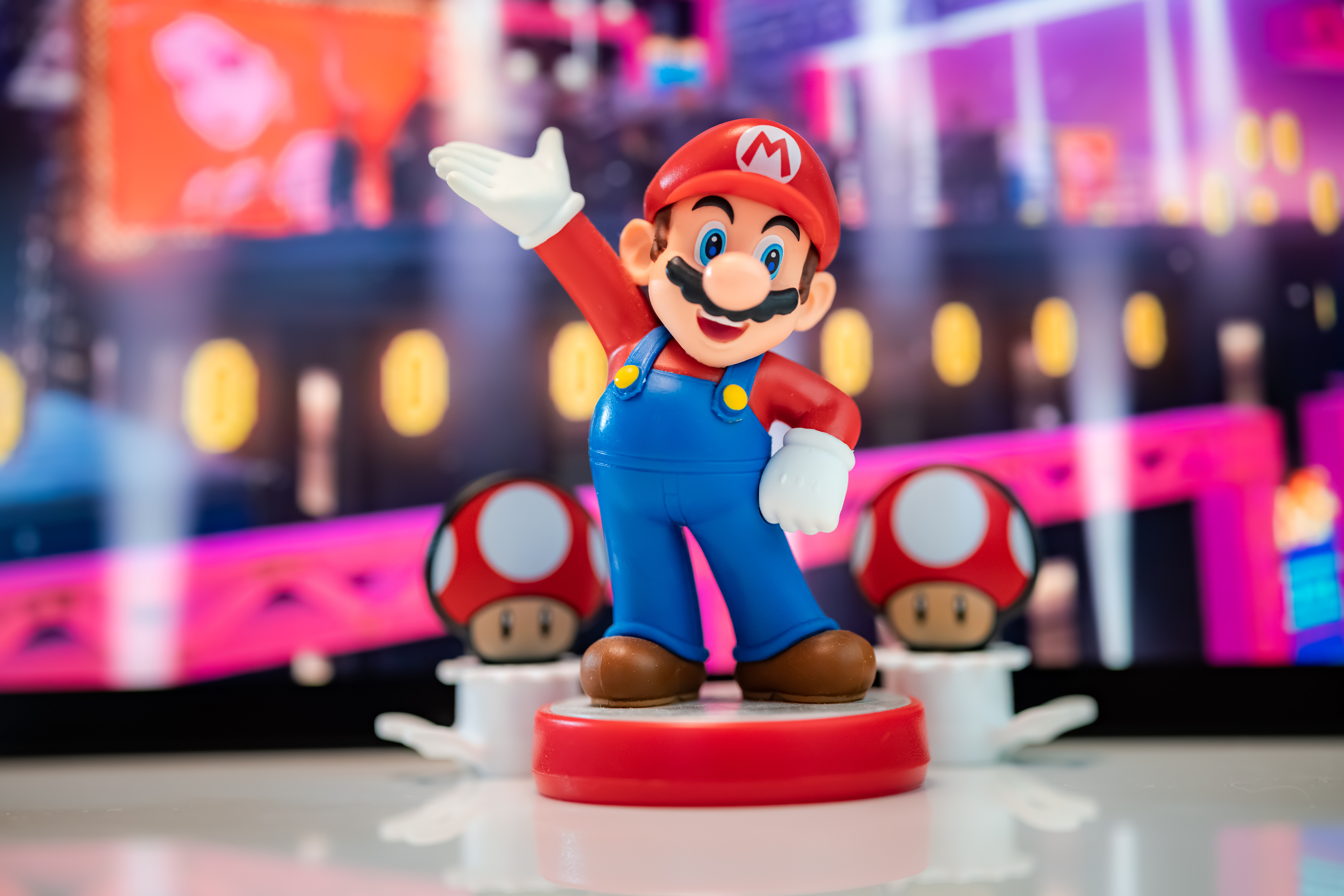
Mario Day lands every year on March 10 because "MAR10" reads like "Mario" - a fan-made bit of wordplay that Nintendo eventually began officially acknowledging and promoting in the mid-2010s.
The Super Mario Bros. (1985) game sits at a pivotal business moment not just for Nintendo but also for console gaming in North America. Coming off the early-1980s market crash, Nintendo's NES marketing strategy depended on a "must-play" title that could justify buying the hardware in the first place. Super Mario Bros. became exactly that kind of killer title, one canonical example of a single piece of software pulling an ecosystem forward. It helped establish the side-scrolling platform as the dominant genre for decades, and its ramifications are hard to overstate. Mario wasn't just a popular character; Super Mario Bros. was a repeatable game design with tight physics, readable worlds, escalating challenge, and musical/visual motifs that made levels memorable even when storage and fidelity were limited.
From there, the Super Mario collection turned into Nintendo's most reliable way to communicate a promise that the game will be approachable, polished, and inventive. Across mainline entries and spin-offs (think 2D and 3D platformers, racing, party games, and RPGs), Mario became relevant and engaging for new players while remaining a comfort food for lapsed ones. That longevity shows up in the most basic metric possible: cumulative software sales. Public tallies routinely put Super Mario series sales in the hundreds of millions of copies worldwide, placing it among the best-selling series in all of gaming. As of December 31, 2025, Mario Kart 8 Deluxe sits at 70.59 million units sold on Switch, and Super Mario Odyssey at 30.27 million units sold.
Those sales numbers would be career-defining for most publishers, but for Nintendo, they function as durable, years-long demand engines. That's what "platform business" looks like when your top intellectual properties (IP) don't just spike at launch; they compound value over the entire lifecycle of the hardware through bundles, storefront presence, word-of-mouth, and family-to-family handoffs. It is also why the Super Mario franchise is so important to Nintendo's margin structure.
Mario's impact also extends beyond games in a way that has become increasingly central to Nintendo's corporate strategy of using IP as a "flywheel" that expands touchpoints. In their own financial-results Q&A, Nintendo president Shuntaro Furukawa framed The Super Mario Bros. Movie as "an opportunity for people of all ages... to come in contact with our IP." He also emphasized that what mattered most is how it "inspires interest in Mario games" and supports Switch hardware and software. The movie's scale makes his logic obvious. The film grossed roughly $1.36B worldwide, turning Mario into a rare modern example of a game character with true theatrical reach. Even if you never buy the idea that films sell games in a direct way, Nintendo's own commentary is a case study in brand extension through broadening awareness, creating new entry points, and then using the resulting attention to refresh demand for not just games and subscriptions, but also park and merchandise experiences.
At an industry level, Mario's influence is partly about mechanics and partly about standards. Mechanically, Super Mario Bros. helped define how 2D movement should feel through acceleration, momentum, jump arcs, and camera behavior, and later did something similar for 3D navigation and spatial readability. Culturally, the Mario franchise helped cement the idea that games could be for everyone without being too simplistic. A Super Mario game can be finished by casual players and still hide mastery paths for speedrunners and completionists. That design philosophy of "low barrier, high ceiling" has echoed across entire genres and still informs how many studios think about difficulty, accessibility, and teachable complexity.
That's why Mario Day works as more than a meme holiday. On March 10, the celebration isn't just "remember Mario." It is a reminder of a rare franchise that has repeatedly reshaped what players expect from platforming and what the broader entertainment world now expects from game IP when it's treated as a long-term asset rather than a one-release event.