The Evolution of Faith in America
Written by Arbitrage • 2026-04-28 00:00:00
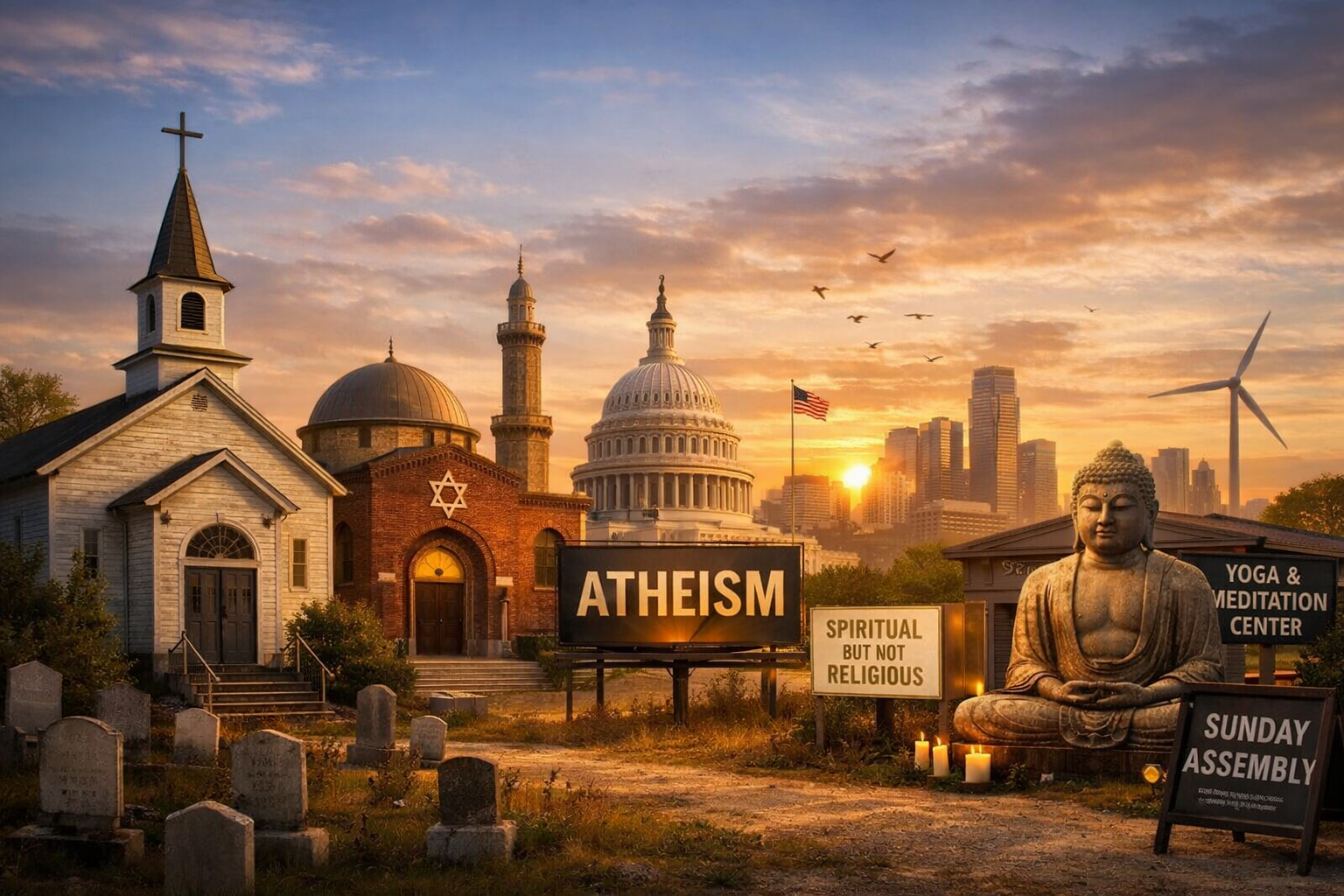
The religious landscape in the United States is undergoing a profound transformation - one that reflects broader shifts in culture, generational identity, and even the way Americans define belief itself. While religion continues to play a meaningful role in millions of lives, the data shows a country that is both less traditionally religious and more spiritually diverse than at any point in modern history.
For much of the 20th century, the United States stood out among developed nations for its high levels of religious affiliation, with Christianity dominating the cultural and social fabric. That dominance, however, has steadily declined over the past twenty years. According to the Pew Research Center, the share of Americans identifying as Christian has fallen from 78% in 2007 to about 62% today, a significant demographic shift in a relatively short period. This decrease, while steep, appears to have slowed in recent years, suggesting that the U.S. may be entering a new equilibrium rather than continuing its secularization trend.
The rise of those who identify as religiously unaffiliated (often referred to as "nones") has been one of the most defining features of modern American religion. Roughly 29% of U.S. adults now identify with no religion, nearly doubling from 16% in 2007. While this group includes atheists and agnostics, a large portion consists of individuals who describe themselves as "spiritual but not religious." This reflects a shift away from organized religious institutions rather than from belief itself. In fact, despite declining affiliation, spiritual belief remains widespread, with surveys showing that more than 80% of Americans still believe in God or a higher power.
Generational change is perhaps the most powerful driver of these trends. Younger Americans are significantly less likely to identify with organized religion than older generations, with only about 45% of adults aged 18 to 29 identifying as Christian. Sociologists often point to "generational replacement" as a key mechanism, where older, more religious cohorts are gradually replaced by younger, less affiliated ones. As sociologist Penny Edgell observed, "This is a broad-based social change," capturing the scale and depth of the transformation. There are emerging indications that some members of Generation Z are rediscovering faith, often motivated by a search for community, meaning, and stability in an increasingly fragmented and digital world. As one religious observer noted, younger people are "seeking comfort and connection," highlighting religion's enduring role as a source of identity and belonging.
America's religious composition is also becoming more pluralistic. While Christianity remains the majority faith, non-Christian religions such as Islam, Hinduism, and Buddhism are gradually increasing their share of the population, driven in part by immigration and demographic changes. These communities tend to be younger and more diverse, contributing to a broader redefinition of what religion in America looks like. The result is a religious ecosystem that is less homogeneous and more reflective of global diversity.
Equally important is the shift in how religion is practiced. Traditional measures of religiosity (such as church attendance and formal membership) have declined sharply. Fewer than half of Americans now belong to a house of worship, a historic low that underscores the weakening of institutional religion. Now, many individuals are constructing personalized belief systems, blending elements from different traditions or focusing on private spiritual practices rather than communal ones. This decentralization of faith represents a structural change, not just a numerical one.
Despite these shifts, religion continues to hold significant cultural and personal importance. Many Americans still turn to faith during times of crisis, celebrate religious holidays, and draw on spiritual frameworks for moral guidance. Religious leaders across traditions emphasize this continuity. As one pastor recently remarked in response to declining attendance, "The hunger for meaning hasn't disappeared - only the way people seek it has changed." This sentiment is echoed across multiple faith communities.
Ultimately, the current state of religion in America is best understood as a complex reconfiguration. The country is moving away from a model dominated by organized Christianity toward a more individualized, diverse, and fluid religious landscape. While institutional affiliation may be weakening, the underlying human search for purpose and connection remains as strong as ever.