What Teachers Wish Parents Knew, How Teaching Changed After AI
Written by Arbitrage • 2026-10-05 00:00:00
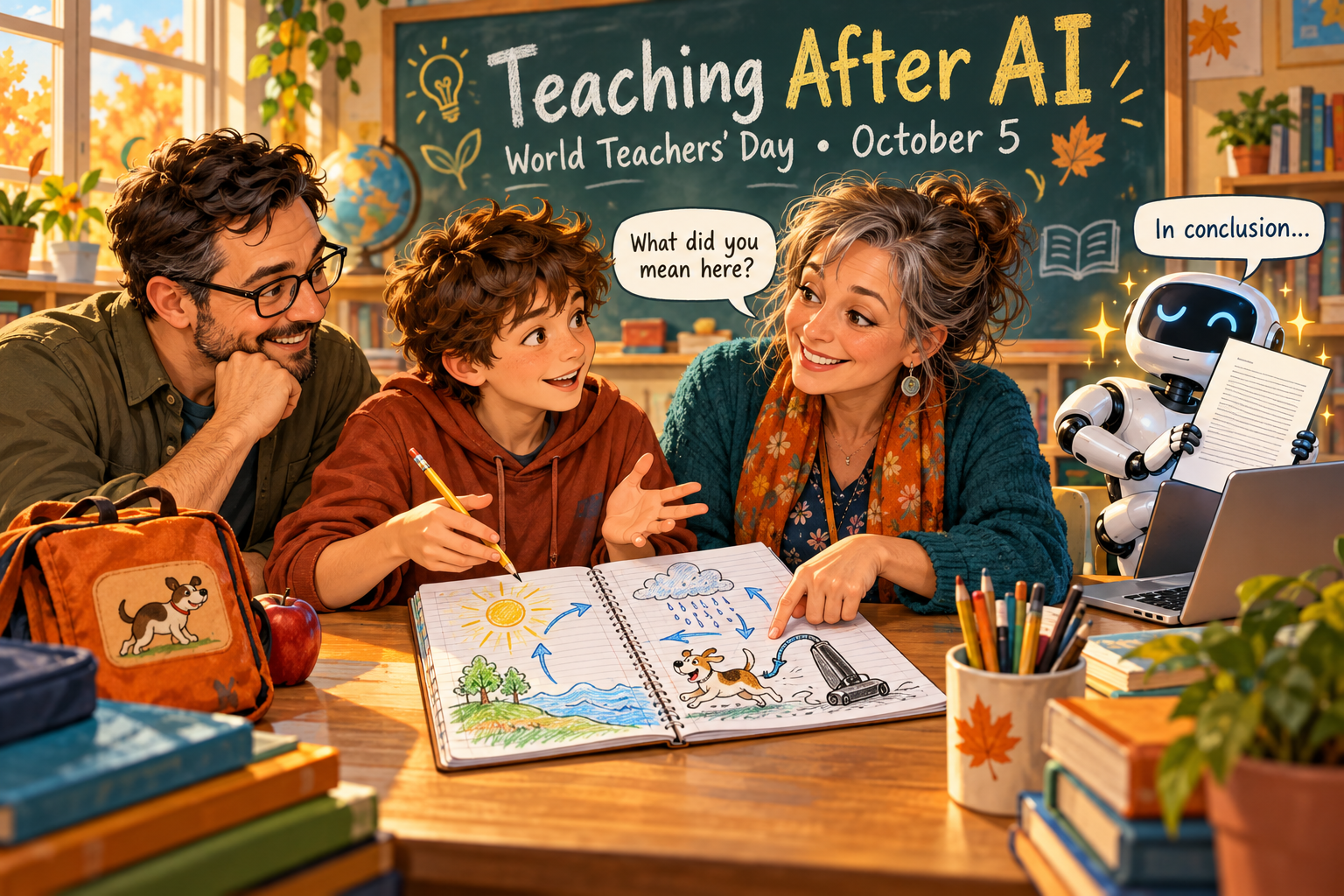
Today, October 5th, is World Teachers' Day so lets talk about perhaps the most important influence in your life outside of family and that annoying boss. Teachers have a short list of things they would say during a confessional. First: your child is probably fine. Second: the class group chat is not a courtroom. Third: AI did not replace the teacher, it just moved the chaos from the worksheet to the chat window, where it now arrives fully formatted, slightly too polite, and weirdly fond of the phrase "in conclusion."
What teachers wish parents knew has not changed as much as the software has. Kids still forget their lunch, still announce they are done with school forever on a Tuesday, and still learn best when an adult at home treats homework like a team sport instead of a surprise audit. The new part is that a finished paragraph is no longer proof of a finished thought. A teacher can spot an AI essay the way a parent can spot a room that was cleaned by shoving everything under the bed. The commas are perfect. The voice is missing.
Teaching after AI is less about catching cheaters and more about asking better questions. "What did you mean here?" has become the most useful sentence in the building. Some teachers have students write the first draft by hand, then use a chatbot only to argue with it. Others ask for the prompt history, which is the modern equivalent of showing your work. It is slower, and it is also the point. The machine can produce a summary of the water cycle. It cannot yet explain why your kid compared evaporation to the family dog leaving the room when the vacuum starts.
Parents sometimes arrive armed with a printout and a theory. Teachers would rather have the boring details: sleep, breakfast, whether the assignment was opened before 11:40 p.m. AI makes it easy to look prepared and still be lost. A five-minute conversation at the kitchen table still beats a flawless paragraph nobody remembers writing. If the child can tell you the story in their own messy words, the learning happened. If they cannot, the essay is just a very confident ghost.
Humor helps, because the alternative is a staff meeting about academic integrity in the age of large language models, which is how joy goes to die. Teachers joke that their new coworker never takes a sick day, never loses the attendance sheet, and also cannot tell when a seventh grader has pasted in a paragraph about the French Revolution that somehow mentions leveraging synergies. Students joke back. The good classrooms have turned the tool into a character: useful, a little smug, and not allowed to speak for anyone without a human edit.
The wish, underneath the jokes, is simple. Parents do not need to become prompt engineers. They need to stay curious about the kid in front of them. Ask what was hard, what was copied, what they would change if the robot were not in the room. Teaching changed after AI. Childhood did not. The best classrooms are still the ones where a child is allowed to be unfinished, and a parent is willing to hear the rough draft out loud.