The Holiday Travel Survival Guide: Airports, Gas Prices, and Family Group Chats
Written by Arbitrage • 2026-11-23 00:00:00
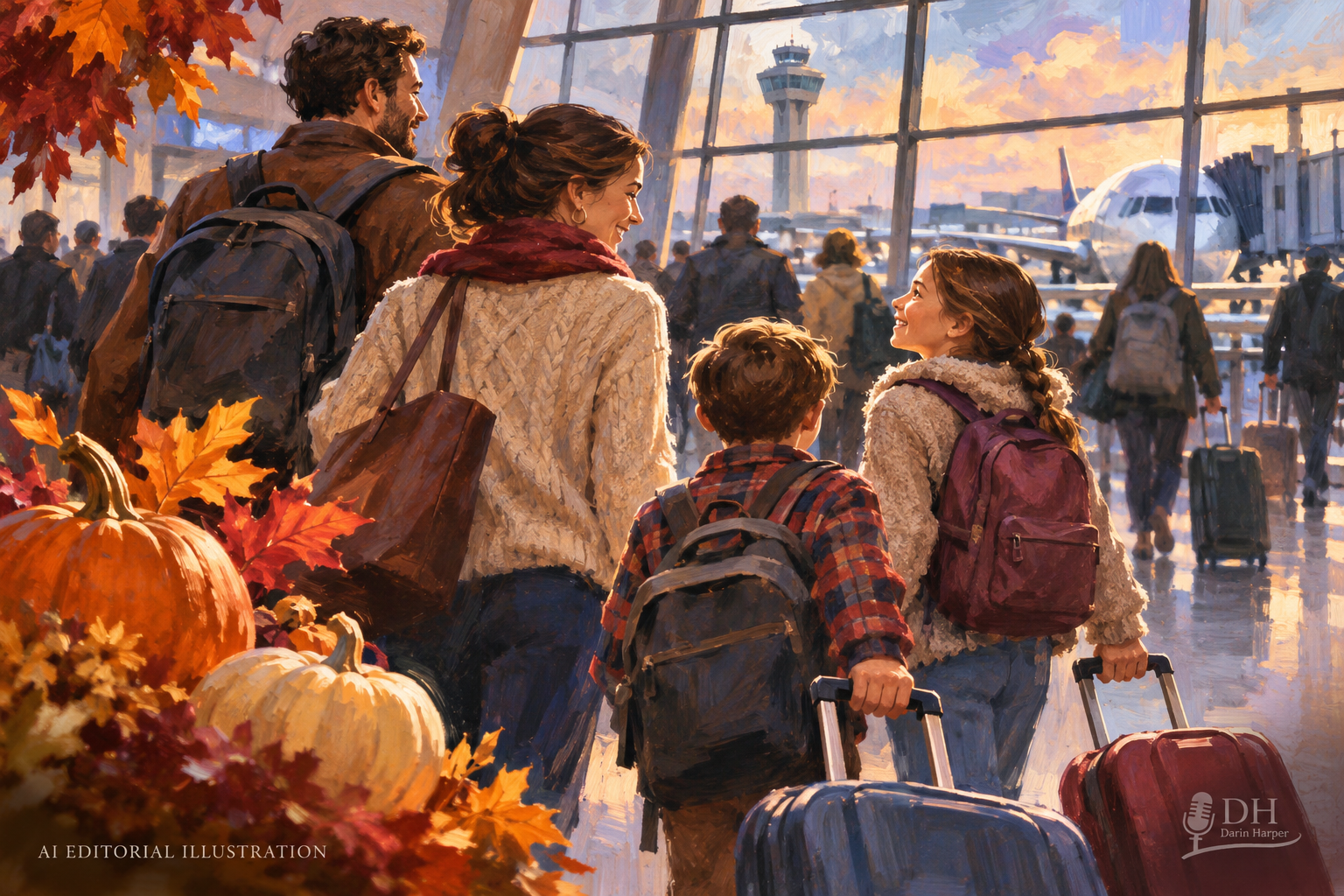
Thanksgiving week has arrived, which means millions of Americans are preparing for the annual holiday tradition of voluntarily entering traffic jams and airport security lines because somebody's mother said, "It just wouldn't be Thanksgiving without everybody here." AAA expects about 81.5 million Americans to travel at least 50 miles from home between November 24 and November 30, including nearly 73 million traveling by car. U.S. airlines expect to carry almost 29 million passengers between November 20 and November 30, with Sunday, November 29 and Monday, November 30 projected to be the busiest flying days. The first rule of holiday survival is therefore simple: leave earlier than you think you need to. The second is to ignore the relative who texts the family group chat at 7:42 a.m. asking, "What time are we leaving?" despite the itinerary having been pinned there since Halloween.
Driving at least brings one piece of somewhat better news. Gasoline prices have been falling rapidly heading into Thanksgiving. AAA's national average for regular gasoline was about $3.64 a gallon on November 23, down from $4.29 a month earlier, although still well above last year's $3.07. Tennessee drivers have it somewhat better, with regular averaging about $3.26 a gallon today. That decline should take a little sting out of a Memphis-to-Nashville, Knoxville, Atlanta, or Grandma's-house road trip, but families are still operating in a world where prices generally are much higher than they were several years ago. The Bureau of Labor Statistics says consumer prices have risen 22% over the five years ending in October 2026, food is up 24%, transportation 22.9%, and gasoline 31.9%. So yes, the gas tank is getting cheaper than it was last month. No, your wallet has not forgotten the last five years.
Flying has its own version of holiday economics. Airlines are adding capacity for Thanksgiving, but they are also dealing with unusually high jet-fuel expenses, and airfare prices were already 22.4% higher year over year in September. Once you add checked bags, airport parking, rental cars, food at the terminal, and the $6 bottle of water you purchase after security because apparently hydration has become a luxury product, the trip can get expensive quickly. Download the airline app, check in before arriving, know the baggage rules, keep medications and essentials in your carry-on, and build extra time into connections. If you are driving, fill up before the holiday rush, check the tires and battery, and pack snacks. Nothing improves family harmony quite like discovering that four adults are hungry while sitting motionless on the interstate.
Then comes the part no travel website can solve: family dynamics. Holiday gatherings combine travel fatigue, financial pressure, old relationships, different expectations, and occasionally the person who believes Thanksgiving dinner is the perfect setting to settle a dispute from 2009. Holiday stress is extremely common. An American Psychological Association survey found that 89% of adults reported at least one source of holiday stress, with money concerns among the leading causes, while a later psychiatric survey found nearly one-third of adults worried about challenging family dynamics. The best preparation may therefore have nothing to do with luggage. Lower your expectations. Do not try to fix every relationship between the turkey and pumpkin pie. Give people some breathing room, volunteer to take a walk, play with the kids, watch football, help with dishes, or develop a sudden fascination with checking whether the car is locked. Sometimes healthy boundaries look remarkably similar to taking out the trash for twenty minutes.
And yes, some people respond to Thanksgiving-night stress by finding the nearest bar, while others discover that Aunt Linda's wine bottle somehow needs to be opened before the turkey is carved. Alcohol can become more prominent during holiday gatherings, particularly when people are stressed, lonely, anxious, or trying to tolerate a conversation they would rather not be having. The National Institute on Alcohol Abuse and Alcoholism specifically warns that people who normally drink moderately may overindulge during the holidays and recommends offering appealing nonalcoholic drinks, eating while drinking, and arranging safe transportation. Wine can accompany Thanksgiving dinner; it should not become the family conflict-resolution department. If the evening reaches the point where somebody says, "I've been meaning to tell you something for twenty years," switching to coffee may be an excellent investment. And anyone who has been drinking should hand the car keys to someone who has not.
The real Holiday Travel Survival Guide is therefore less about perfectly executing the trip and more about accepting that Thanksgiving travel is organized chaos with gravy. Budget more than you think you will spend, leave earlier than necessary, expect delays, keep the itinerary simple, and assign responsibilities instead of assuming everybody read the group chat. Remember that inflation has made travel and entertaining more expensive, so there is nothing wrong with sharing costs, simplifying the menu, shortening the trip, or saying no to an unnecessary expense. Most importantly, remember why everyone went through all this trouble in the first place. The goal is not the perfect flight, the fastest interstate route, the flawless Thanksgiving table, or getting fourteen relatives to acknowledge the same text message. It is getting together, enjoying the people you actually enjoy, surviving the people who test that theory, and making it home safely with enough leftovers to justify everything.