The Contrarian's Favorite Indicator, and What It Actually Measures - Part 1
Written by Arbitrage • 2026-08-24 00:00:00
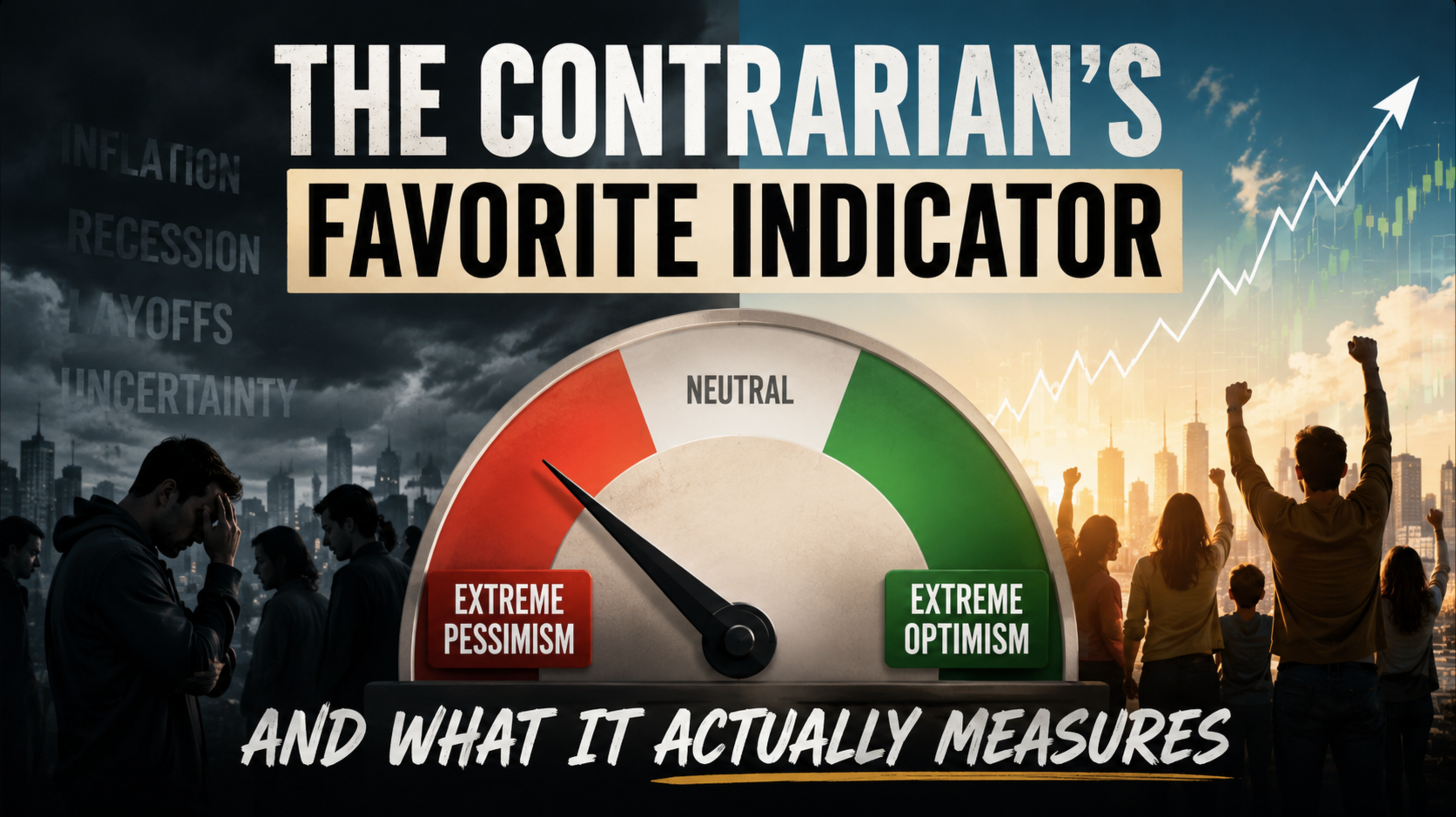
Three numbers from the past three weeks, all describing the same economy, none of them agreeing with each other.
On 14 August, the University of Michigan's preliminary Index of Consumer Sentiment printed 51.0, down 7.6% from July's final 55.2 and short of the 54.5 consensus. The same morning, the Census Bureau reported retail and food services sales fell 0.6% in July to $763.6 billion, the first monthly decline since October 2025. And the S&P 500 closed at 7,798.99, its 27th record close of the year, up 13.4% year to date.
Soft data close to historic lows. Hard data cooling but still positive year over year. The index at all-time highs. The instinct is to work out which of the three is lying. The more useful move is to accept that they measure different things on different clocks, and that the gaps between them carry information the individual prints don't.
Two surveys, two different questions
Michigan and the Conference Board get used interchangeably in commentary. They aren't interchangeable. Michigan leans toward household finances and the experience of inflation. The Conference Board's index is weighted more toward employment and labor conditions, and it's the more volatile of the two. Both split into a current component and a forward component, and that split is where the usable content sits.
For Michigan in August, current conditions came in at 51.8 and expectations at 50.6. Survey director Joanne Hsu noted that views of personal finances saw only minor declines, while expected business conditions fell 11% for the short run and 17% for the long run. Households aren't reporting that their own situation collapsed. They're reporting that they think the broader economy is about to.
The Conference Board's July reading had the same shape. The headline fell 1.4 points to 90.8. The Present Situation Index fell 3.6 points to 114.9, its third consecutive monthly decline. The Expectations Index held unchanged at 74.7. The pessimism is concentrated in the forward-looking component, not the assessment of present conditions.
Worth stating explicitly, because the language gets sloppy: consumer sentiment is not investor sentiment. Michigan and the Conference Board survey households about the economy. AAII, NAAIM and the positioning measures capture market participants. Different populations, different questions, different relationships to forward returns.
Does the consumer lead the market, or does the market lead the consumer?
The intuitive chain runs: consumers feel worse, spend less, earnings deteriorate, equities fall. Sentiment leads, price follows. It's a clean story, and it's mostly backward.
Work by Fisher Investments found that low Consumer Sentiment Index readings failed to precede 11 of the last 12 bear markets. In those episodes, stocks had already fallen materially by the time sentiment cracked. The survey registered the damage rather than anticipating it. Three structural reasons explain why.
- Equity prices are a component of the Conference Board's Leading Economic Index. The market is formally classified as a leading indicator; the surveys are not, and price action is one of the inputs households draw on when forming a view.
- Survey questions ask about conditions respondents have already experienced. Petrol prices, grocery bills, job security, the last statement they opened. Backward-looking inputs by construction, however forward-looking the wording.
- The wealth effect runs in the unhelpful direction. Rising equity prices lift sentiment among upper-income households, who account for a disproportionate share of consumption. That inverts the assumed causality.
Add timing to that. The August preliminary drew on responses collected between 28 July and 10 August. By the time a print lands, the market has spent weeks pricing the same information. As a forward-looking indicator for equity direction, sentiment sits closer to coincident or lagging than leading.
Come back tomorrow for Part 2 of this topic!
This publication is produced by Arbitrage Trade for informational and educational purposes only. It does not constitute investment advice, a recommendation to buy or sell any security, or an offer or solicitation of any kind. The analysis presented describes historical conditions and observable patterns and should not be interpreted as a forecast or prediction of future results. Past performance is not a reliable indicator of future results. Any securities, indices or instruments referenced are illustrative only. Readers should conduct their own research and consult a qualified financial professional before making any investment decision.