Nothing Stops This Train: The Credit Expansion That Holds Banking Together - Part 1
Written by Arbitrage • 2026-01-16 00:00:00
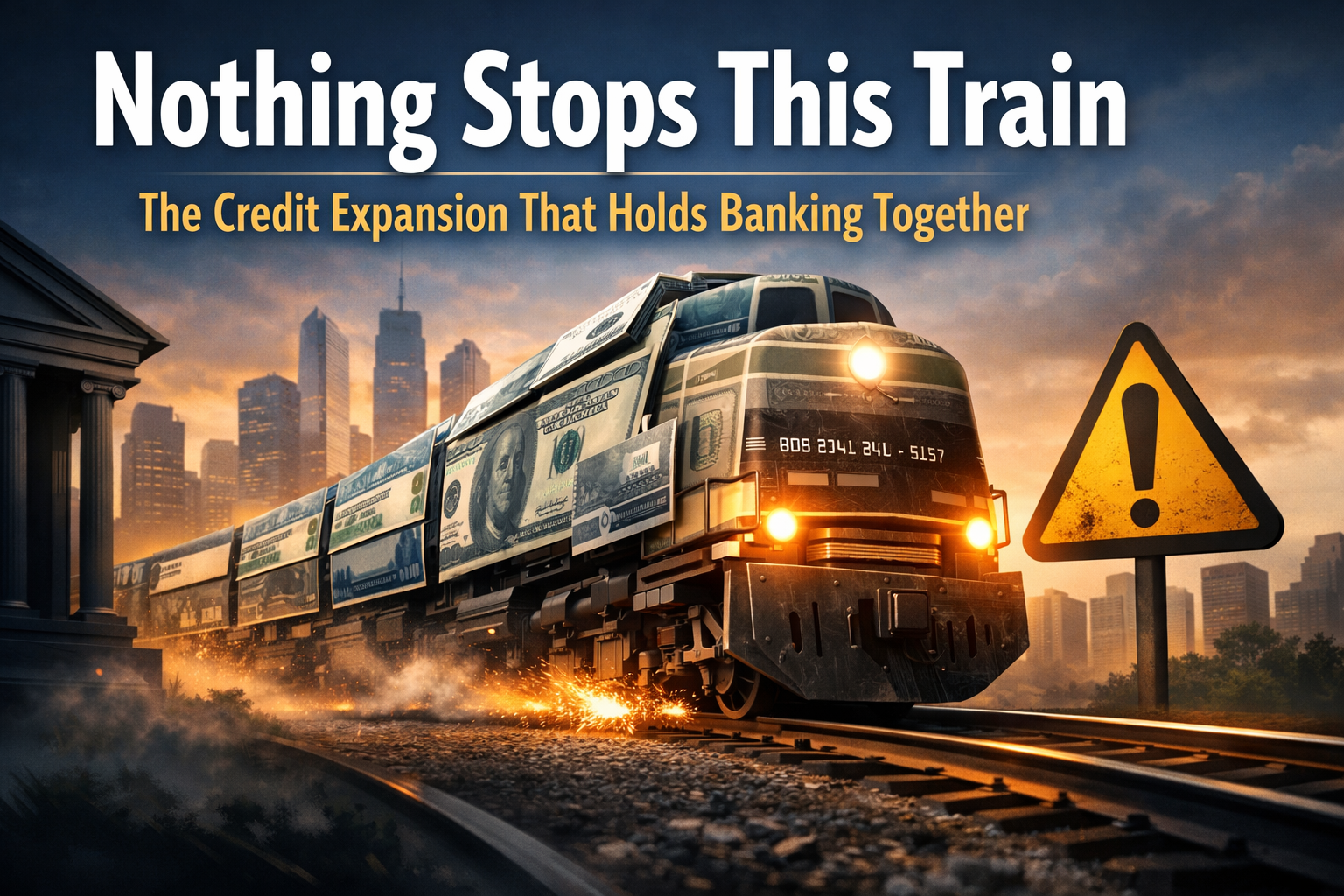
The train metaphor: banking only "works" while it's moving.
Here's the thing most people don't want to say out loud: modern banking is not built to sit still. It's built to move.
Fractional reserve lending (or more accurately in today's world, fractional capital banking) works best when balance sheets are expanding, credit is flowing, assets are holding their value, and everyone believes tomorrow is going to look roughly like today. Once you accept that, a lot of "mysteries" about financial crises stop being mysterious. That's why Lyn Alden's "Nothing Stops This Train" framing hits so hard. When you zoom out, the system is designed to avoid one thing above all else: a hard stop. Because a hard stop is not a neat, contained event. It's a chain reaction.
Now, to be clear: I'm not saying credit can never slow down. It does. Recessions happen. Banks tighten standards. People default. The point is that the system becomes unstable when credit creation system-wide stalls or reverses sharply. The train doesn't derail because one passenger stands up. It derails when the engine loses power and everyone rushes the exits at the same time.
So let's make this simple. Credit expansion is the grease in the machine. When it stops, the machine starts eating itself. And when a bank can no longer create credit in a meaningful way, it isn't just "conservative." It's becoming a zombie.
The simple mechanics: banks create credit, not just move money
Most people still picture banks like this: People deposit money. Bank lends out some portion. Bank is basically a middleman. That story is comforting. It's also not how modern money creation mainly works. In the modern system, commercial banks create the majority of broad money when they make loans. When a bank extends a loan, it simultaneously creates a matching deposit in the borrower's account. In other words, loans create deposits.
This isn't "crypto Twitter theory." It's straight from central banking and research institutions:
- The Bank of England explicitly explains that banks do not merely lend out existing deposits and that lending creates deposits.
- The BIS describes how banks generate transaction deposits by extending loans (and destroy them when loans are repaid).
- The Philadelphia Fed gives a clean balance-sheet example: loan asset goes up, deposit liability goes up, and a deposit is created even if nobody walked in with that cash.
So what constrains lending? Not "having deposits first," at least not in the way people think. The real constraints are more like:
- creditworthiness (can this borrower realistically pay)
- collateral and asset prices (what's backing the loan, and will it hold value)
- bank capital (can the bank absorb losses and still meet requirements)
- funding and liquidity (can the bank handle withdrawals and settlement)
- confidence (the hidden variable that turns stable into panic overnight)
This is why credit expansion is not just a "nice to have." It's part of how the plumbing functions.
Why credit expansion is the glue holding everything together
Now we get to the heart of it. A modern, debt-heavy economy isn't built on people paying off debts and then chilling. It's built on rolling, refinancing, expanding, and maintaining asset values. Think about how much of the economy depends on credit continuing to be available:
- Homebuyers need mortgages.
- Businesses need revolving credit lines.
- Governments roll debt and refinance constantly.
- Markets price assets assuming liquidity exists.
- Consumers finance cars, education, and big purchases.
When credit expands, you get a self-reinforcing loop that feels like "normal life":
- Credit is available
- People borrow and spend/invest
- Businesses earn revenue
- Defaults stay manageable
- Assets hold value
- Banks feel safer lending
- Repeat
But when credit stalls, the loop flips. And it flips fast:
- Banks tighten lending standards
- Marginal borrowers get cut off
- Spending and investment slow
- Revenues drop
- Defaults rise
- Collateral values fall
- Bank balance sheets weaken
- Banks tighten more
- Repeat, but uglier
That's the "implosion" dynamic people are gesturing at when they say the system can't survive without credit expansion. It's not that the universe explodes if credit growth goes from 6% to 3%. It's that sharp, system-wide credit contraction turns normal leverage into a trap. And here's the uncomfortable part: a lot of what people call "stability" is just credit expansion that's been running long enough to feel permanent.
Come back on Tuesday for Part 2 of this topic!