The Late Cycle Playbook: What to Buy, What to Ditch, and When to Get Out - Part 2
Written by Arbitrage • 2026-03-19 00:00:00
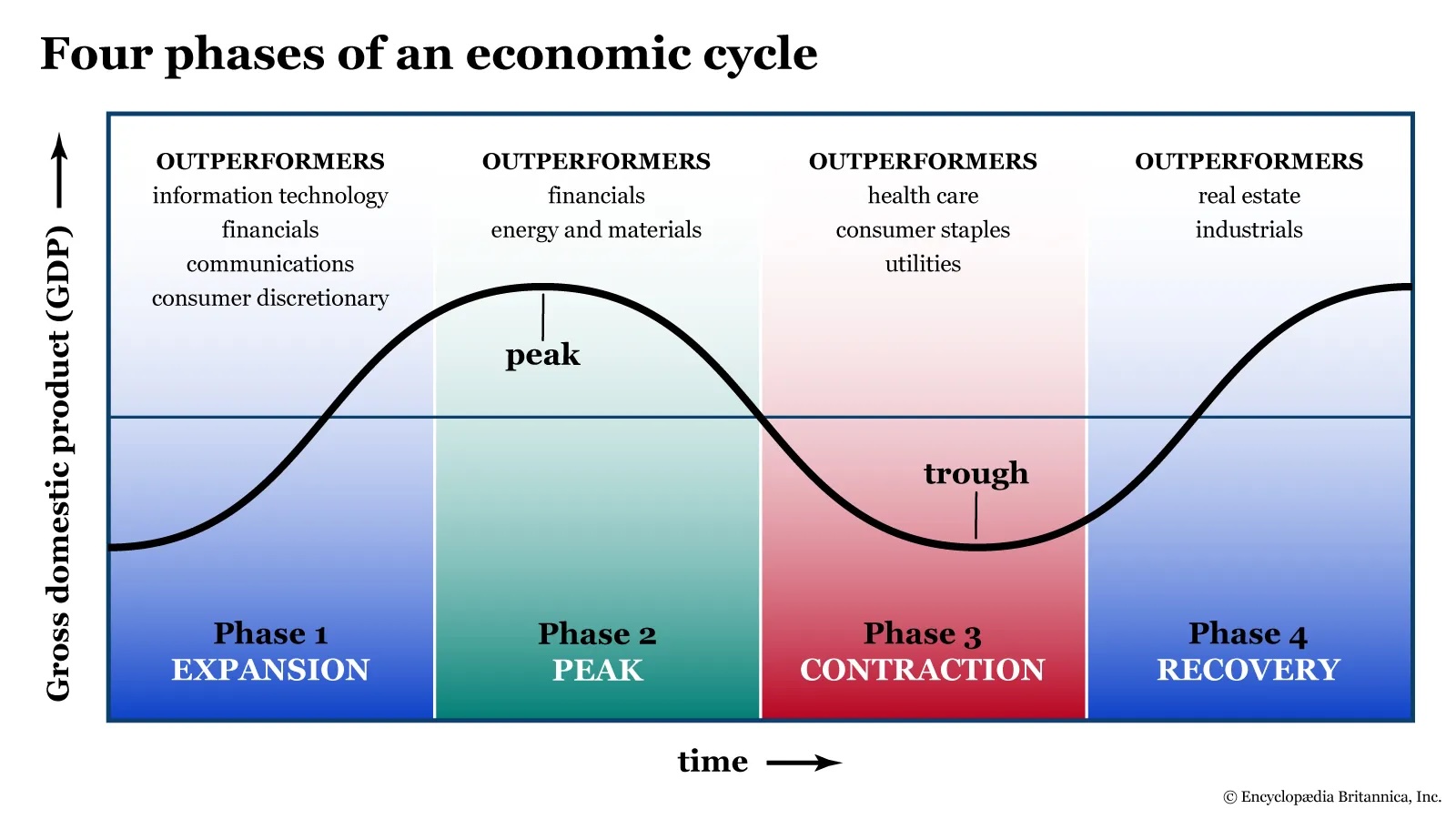
If you have not read yesterday's blog post, please do so before continuing here.
What the S&P 500 Does in a Late Cycle
The S&P still grinds higher in the early part of the late cycle - but the easy money is made. What changes underneath the surface is significant:
- Volatility picks up. Drawdowns become sharper and faster.
- Earnings revisions start trending negative - consensus estimates get cut.
- Sector rotation accelerates. Defensives outperform cyclicals.
- The index can still rise, but breadth narrows. A few mega-caps mask the damage.
Historical data from SPDR Americas Research (covering December 1960 to November 2019) shows that during economic slowdowns - the phase straddling late cycle and recession - the top performing sectors averaged 15% returns for Healthcare and strong positive returns for Consumer Staples. Technology, which leads mid-cycle expansions with 21% average returns, was among the weakest performers during slowdowns.
The index-level return looks acceptable. But that masks the carnage in the wrong sectors - and the opportunity in the right ones.
The Playbook: What to Buy
| Asset | Why It Works Late Cycle |
| Energy | Elevated oil prices drive margins. Demand still strong before the demand destruction hits. |
| Healthcare | Non-cyclical demand. People don't stop getting sick because rates are high. Defensive cash flows. |
| Consumer Staples | Pricing power, essential goods, sticky revenue. Walmart +26% in 2025 is illustrative. |
| Gold | Fed pause environment is historically gold-positive. +55% in 2025, now above $5,000/ounce |
| Commodities (broad) | Real assets hold value as inflation stays elevated. Copper, silver, platinum all re-rated in 2025. |
| Short-duration bonds / T-bills | Yield without duration risk. With rates still elevated, T-bills are a legitimate alternative. |
The Playbook: What to Ditch
| Asset | Why It Struggles Late Cycle |
| Consumer Discretionary | Spending slows as consumers feel the squeeze. -14% in Q1 2025 tells the story. |
| High-Multiple Tech / Growth | Multiple compression accelerates as rate cuts get delayed. Nvidia -20% in Q1 2025. |
| Small Caps | More leveraged, more rate-sensitive, less resilient. Hit hardest when credit tightens. |
| Long-Duration Bonds | Still exposed if rates stay higher for longer. Duration risk hasn't gone away. |
| Financials | Credit quality deteriorates, loan growth slows, spread income compresses. |
WHEN TO GET OUT: THE EXIT SIGNALS
The late cycle eventually becomes a recession. The transition is fast, often faster than consensus expects. These are the signals to watch, in order of reliability:
- Unemployment turning up - even a 0.2-0.3% rise from the trough is historically one of the most reliable recession triggers. It's the Sahm Rule in action.
- The Fed pivoting to cuts - counterintuitively, the first rate cut is often a sell signal for equities, not a buy. It means the Fed has seen enough damage to act.
- Credit spreads blowing out - high-yield spreads widening sharply signal that credit markets are pricing in defaults. This precedes equity weakness.
- Oil collapsing after the spike - demand destruction. When oil falls sharply after a late-cycle surge, it signals the economy is contracting, not stabilizing.
- Earnings guidance being pulled - when companies stop guiding, they can't see forward. That's a recessionary signal dressed in corporate language.
WATCH LIST: Right now: unemployment ticking up, consumer confidence at 10-month lows, the Fed on its longest pause of the current cycle, and gold at all-time highs. None of these are the recession signal - but all of them are the late cycle signal. The exit door isn't open yet. But you should know exactly where it is.
THE BOTTOM LINE
The late cycle is not the end. But it is the phase where getting positioning wrong is most expensive. The rotation is already happening. Energy, Healthcare, Staples, and Gold are outperforming. Tech and Consumer Discretionary are underperforming. Gold is at $5,000. Oil spiked. Consumer confidence has been falling for 10 consecutive months. The signals are there for those paying attention.
Most investors are either too early or too late in rotating. They hold growth until it's obvious the cycle has turned - and by then, the defensives have already run. The playbook is simple: rotate to real assets and defensives now, know your exit signals, and don't wait for confirmation from the headlines. By the time consensus agrees we're in a late cycle, the rotation trade is largely done.