Is the U.S. Economy Really Growing? Real vs. Nominal GDP Explained - Part 1
Written by Arbitrage • 2026-02-19 00:00:00
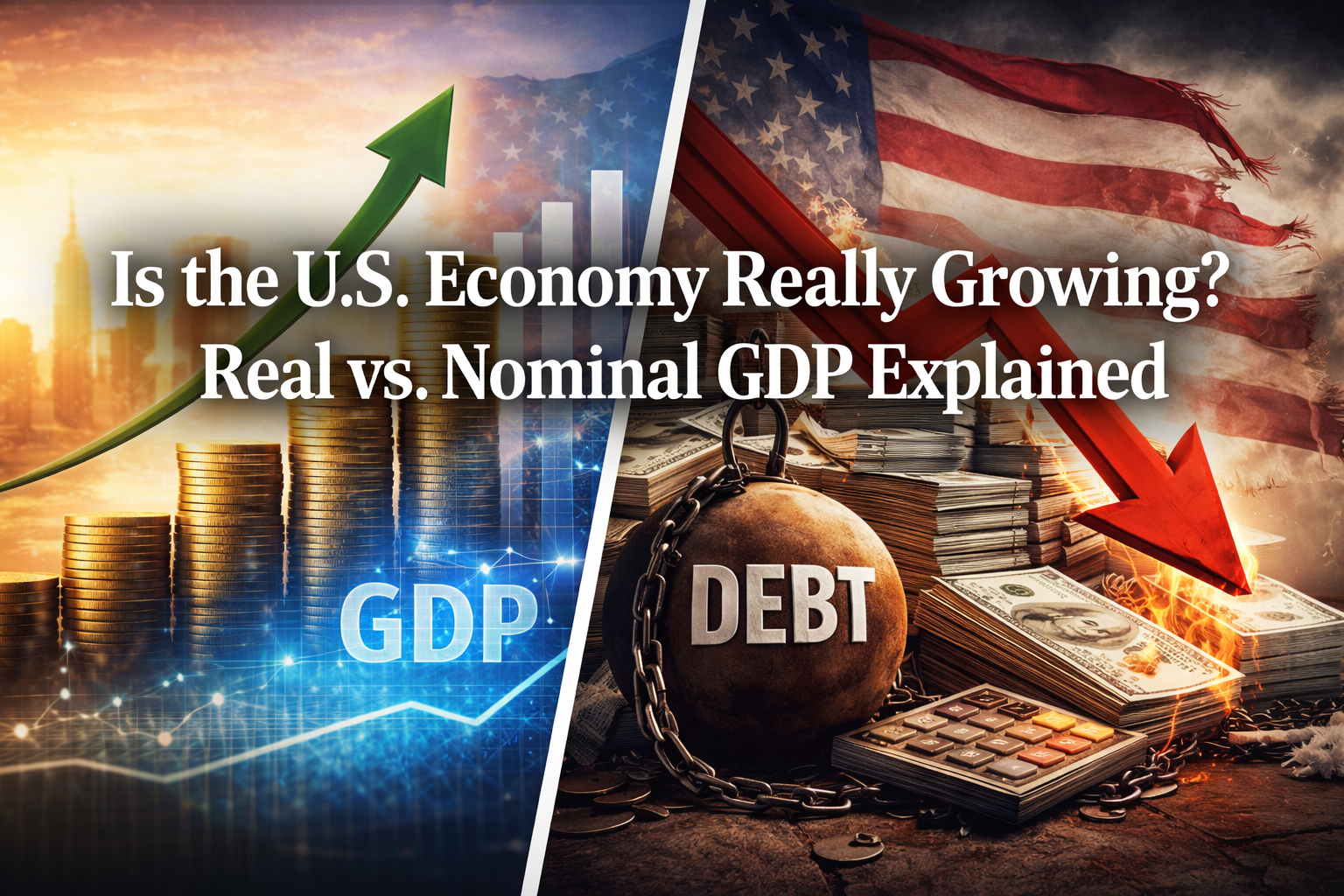
Every quarter, the headlines hit the same way: "The U.S. economy grew at 3.2% annualized." Markets react. Politicians celebrate. Commentators debate whether the economy is strong or slowing. But growing in what sense? Are we producing more goods and services? Are Americans becoming wealthier in real purchasing power? Or are we simply measuring growth in dollars? Dollars that may be worth less than they were a year ago? To answer that, we need to understand the difference between nominal GDP and real GDP. And then we need to go one layer deeper - into debt, financial engineering, and how we define recessions in the first place. Because not all growth is created equal.
Nominal GDP: Growth in Dollar Terms
Nominal GDP measures the total value of goods and services produced in the economy at current prices. If you add up everything produced: cars, software, healthcare, housing, and multiply by today's prices, you get nominal GDP. The problem is that nominal GDP rises when prices rise, even if output doesn't. Imagine an economy that produces 100 units of goods at $1 each. GDP is $100. The next year, it produces the exact same 100 units, but prices rise to $1.10 due to inflation. GDP is now $110. On paper, the economy grew 10%. In reality, nothing additional was produced. This is the first illusion. Inflation can look like growth.
Real GDP: Attempting to Measure True Expansion
Real GDP adjusts for inflation. It attempts to strip out rising prices so we can see whether actual output increased. If nominal GDP grows at 6% but inflation is 4%, real GDP growth is roughly 2%. That 2 percent is meant to represent real expansion - more goods, more services, more productivity. In theory, this is the cleaner measure. It tells us whether living standards are improving.
But here's where things get more complicated. Real GDP depends entirely on how inflation is measured. And inflation is not a fixed number handed down from nature. It is a statistical estimate based on evolving methodologies. Over the decades, the way inflation is calculated has changed. Substitution effects assume consumers switch to cheaper goods when prices rise. Hedonic adjustments account for quality improvements. The basket of goods itself evolves over time. None of this is inherently deceptive. But it does mean that if inflation is understated, real GDP will be overstated. Growth becomes, at least partly, a function of how we measure prices.
A Look Back: Lessons from the 1970s
The 1970s offer an important historical reference point. During that decade, nominal GDP appeared strong. Prices were rising rapidly, and in dollar terms, the economy looked like it was expanding. But real growth was weak. Inflation eroded purchasing power. Wage growth struggled to keep up. Living standards stagnated. It was a classic stagflationary environment in which nominal expansion masked structural weakness. That period reminds us that rising dollar values do not automatically translate into real prosperity. Inflation can inflate the numbers while quietly hollowing out purchasing power.
The Debt Paradox: Growth Borrowed from the Future
Now we move into deeper territory. GDP includes government spending as a direct component. When the government spends more, GDP rises. If that spending is financed by tax revenue, it represents a transfer of existing resources. If it is financed by debt, it represents future claims pulled into the present.
Over the past two decades, and especially after 2008, the United States has increasingly relied on debt-financed spending to stabilize and stimulate the economy. Quantitative easing. Persistent deficits. Pandemic stimulus. Emergency programs are layered on top of structural spending.
Nominal GDP rose sharply after 2020. So did federal debt. The critical question is whether real output has grown faster than the obligations used to generate that output. If debt expands faster than real GDP, then the system is leveraging future productivity to sustain present growth. That is not the same as organic expansion. It is acceleration through borrowing.
Come back tomorrow for Part 2 of this topic!